Danny Kruger MP, 28th October 2025
The British malaise
Polling, focus-grouping, door-knocking, everyone’s own personal experiences confirm the problems with Britain in 2025. Nothing works properly. It’s impossible to build anything. The streets are dirty and unsafe. Taxes and prices are far too high. Immigration is changing our country for the worse and far too fast. Mad dogmas get adopted by our national institutions, while we are chronically exposed to multi-factor threats including economic collapse and foreign attack. We are becoming poor, sick and unhappy. There is a malaise over Britain.
These problems are complex but the effective cause of them is simple. Since 1997 we have had governments that, firstly, don’t respect let alone share the attitudes of the country they govern and, secondly, aren’t properly in charge of the state. From Blair to Sunak our Prime Ministers have succumbed more or less enthusiastically to a raft of ideas – internationalism, identitarianism – that are alien to the instincts and wishes of the British people; and at the same time, in the service of these ideas, they have performed the most extraordinary abdication of power since Parliament handed control of the Army to Oliver Cromwell in 1645.
The Self-Denying Ordinance actually improved the effectiveness of the military, getting aristocratic amateurs out of command and allowing Cromwell to create the New Model Army and win the Civil War. Our generation of leaders have done the opposite. They have created a vast new class of inept decision-makers who, unaccountable to Parliament or even to the Government, have progressively snarled the country in a spaghetti of bureaucracy, ideological nonsense and vested interests – all under the pious rubric of ‘due process’, ‘operational independence’, ‘neutrality’ and ‘the rule of law’.
These sonorous slogans, the shibboleths of the lanyard class who really govern Britain, are put into the mouths of politicians and commentators to denounce anyone, like Reform UK, who want to actually change the way our country works. Yet the reality is these good and important principles – the principles of good government – are themselves betrayed by the lanyard class and their leaders. We have stupid decisions made by unqualified amateurs and second-rate bureaucrats; the plain tolerance of law-breaking; and a system that openly serves the interests of foreign citizens and even foreign regimes rather than our own.
I was at a street stall for Reform UK this weekend and one of our activists said to me, about the Labour government and the Tories – ‘they call themselves the grown-ups but they’re not. They’re just playing at being in government. We need to be the real grown-ups and actually take charge and make things better.’
He is right.
This is the British malaise: our leaders despise the ordinary instincts of ordinary people, and our purported leaders – the ministers elected by the public – are not the real leaders anyway. By contrast, Reform UK will be a government of national preference – preferring the ideas, the institutions, and the people of the United Kingdom over the ideas, institutions and citizens of elsewhere – and we will restore the basis of our democracy, putting ministers properly in charge of the government and answerable to Parliament for their decisions.
That’s the path to prosperity for our country – to make this amazing nation thrive again, with all the natural talent and pent-up passion that is in our communities and our businesses; the decency and industry that still, despite everything, characterizes the British people; the huge opportunities to grow our economy, unite our country and make us happy, healthy and wealthy once again.
The precondition for all that – indeed, the only part of our plan that is totally out of our control – is to get a majority of MPs elected to Parliament who are committed to the principles of national preference and political restoration.
Readiness is all
So let me set out what we will do if we win a majority. I want to discuss four things.
The first thing is this: we will be ready, and the system will be ready.
An important part of our preparation for government is to do it in the open. To ensure that the civil service, the House of Lords and the wider apparatus of the establishment all accept the mandate we hope to win, we need no-one to be able to claim we misled the country about our intentions.
Nigel, Zia and I and our other spokespeople will be making a series of announcements in the months and years ahead, setting out our plans for different policy areas and the different parts of government.
When Nigel Farage walks into No 10 as Prime Minister on the day after the next election, I don’t want the Cabinet Secretary to welcome him in like the latest short-term tenant of the building, sit him down for a briefing on the house rules, and then politely ask if he’d like to change anything about the decor.
I want Nigel Farage – and his Cabinet – to sit the civil servants down and tell them the plan. And the plan is going to be a lot bigger and more structural than a few pieces of decorative legislation.
The paradox is that we want to undo the legacy of the last 30 years – but actually we have something to learn from Blair and from Cameron. In 1997 and in 2010 they each had a plan of sorts. Blair was ready with devolution. Cameron was ready with school choice. Clearly, Starmer wasn’t ready with anything – except Sue Gray, and she wasn’t ready at all. But Blair and Cameron had an idea of what they wanted to do and they had legislation drafted for the purpose.
That is what Reform is doing now. We are working with policy specialists, with lawyers, with Parliamentary draftsmen, and with a whole range of serving and former officials who are helping us plot a path through the thicket of Whitehall and Parliamentary process to the destination, which is a fulfilment of the manifesto we hope to be elected on.
We will have legislation drafted. A new Ministerial Code and Civil Service Code. Orders in Council prepared. People lined up for key appointments. And it will all start on Day 1.
Grip the machine
A British government with a mandate and a majority is – in theory – a powerful thing. What is needed to make the theory real is political will, to face down the howls of outrage from people thinking they are being conservative by invoking the conventions of five minutes ago against a government that is trying to restore the genuine basis of the constitution.
So the second thing we will do is we will grip the civil service itself. The restoration of the authority and responsibility of ministers starts with resuming authority and responsibility over their own officials.
It is simply not acceptable, and it won’t be accepted by a Reform government, that ministers have to take advice from, and trust the execution of their decisions to, officials who answer to different bosses and whom they cannot – except with absurd laboriousness and slowness – remove from their posts.
We will reform the Civil Service Code to ensure that officials at the top of the civil service, and certainly those at the centre of government, are directly answerable to politicians, including for their jobs. And we will bring more expertise, advice and executive capability from outside government, to serve in Whitehall.
But let me be very clear – the growth of the civil service will be reversed.
In the last 30 years Whitehall has swollen vastly beyond its proper bounds. After the financial crisis in 2008 the headcount of the civil service started falling but – and here my former party is highly culpable – after Brexit it resumed the inexorable growth, passing the 500,000 mark in 2023.
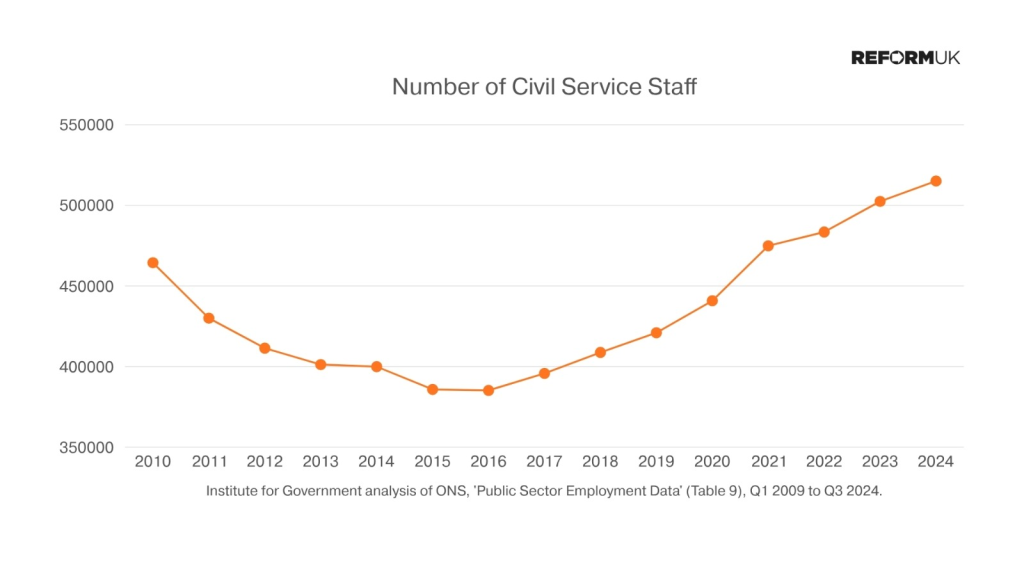
We put the civil service on notice that under a Reform government we expect the headcount to fall – dramatically. We are not setting a target yet because we haven’t set out the functions, let alone the form, of the government we want to lead. But clearly, Britain doesn’t need half a million civil servants. We can automate a lot of these jobs; we can improve officials’ productivity to reduce headcount; and we can pass responsibility to local councils and civil society.
Headcount reductions in Whitehall
We want to significantly reduce the headcount of the civil service, with a particular emphasis on cutting the head office functions like policy, comms and HR.
Given the increases in headcount since 2016, overall a 30% cut in the civil service should be easily achievable, with much higher proportions in head office functions. For instance:
– A 50% cut in the policy function – taking us back to 2016 levels – would save 17,000 staff.
– A 50% cut in HR – bringing this function into line with the HR profession’s recognised benchmark of 1:100 staff – would save 6,000 staff.
– A 70% cut in comms – a cut which speaks for itself – would save 3,000 staff.
Whitehall Monitor 2025Statistical bulletin – Civil Service Statistics: 2025 – GOV.UK (table D1)
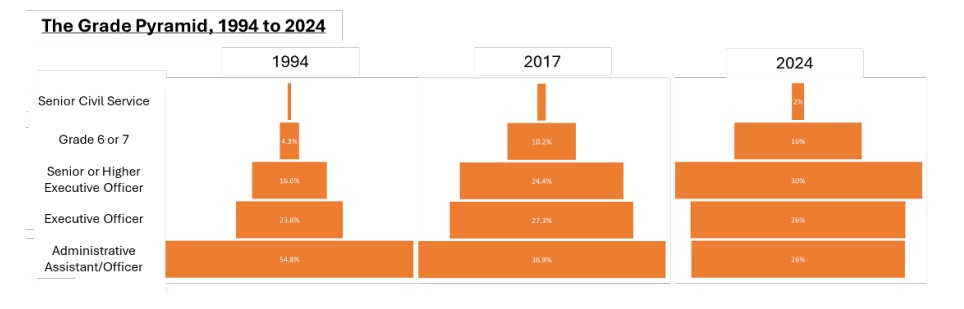
And as we reduce headcount we will be alert to the tricks that were pulled while the Coalition government was cutting Whitehall and freezing pay. What happened was that all the officials who were left just promoted themselves, so they got paid more by being in a higher grade – and the overall wage bill of the civil service didn’t come down at all. This graphic shows the change between 1994, when the civil service represented a pyramid with a wide base – like all normal organisations – to 2024, when it’s basically a pillar.
Stephen Webb, Smaller, Better, Higher Paid?, Policy Exchange 2025
That chart is madness. We will have a smaller civil service and it will be shaped like a pyramid again.
And as we do that we can do something else – and this is another thing I hope the civil service will be ready for when we come into office.
In the last 30 years as the size of government grew so did its physical footprint – both beyond London and in Westminster. Britain used to administer an empire from a couple of buildings grouped around Downing Street. In the 1820s Sir Robert Peel ran the Home Office (which covered most domestic policy) with 17 officials. Lloyd George delivered the People’s Budget in 1911 with a Treasury of 26 people.
In those days Westminster was a residential district – now it’s a wasteland of acronyms – the MOJ, the DWP, the DfT, the DfE, the DHSC, the MHCLG – all housed in glass and steel towers, mostly empty because half the civil servants are working from home.
The future can look a lot like the past. Our ambition is to make Whitehall Whitehall again – to restore the civil service to the street called Whitehall. In the next Parliament a lot of the buildings housing these ministries will come up for lease renewal.
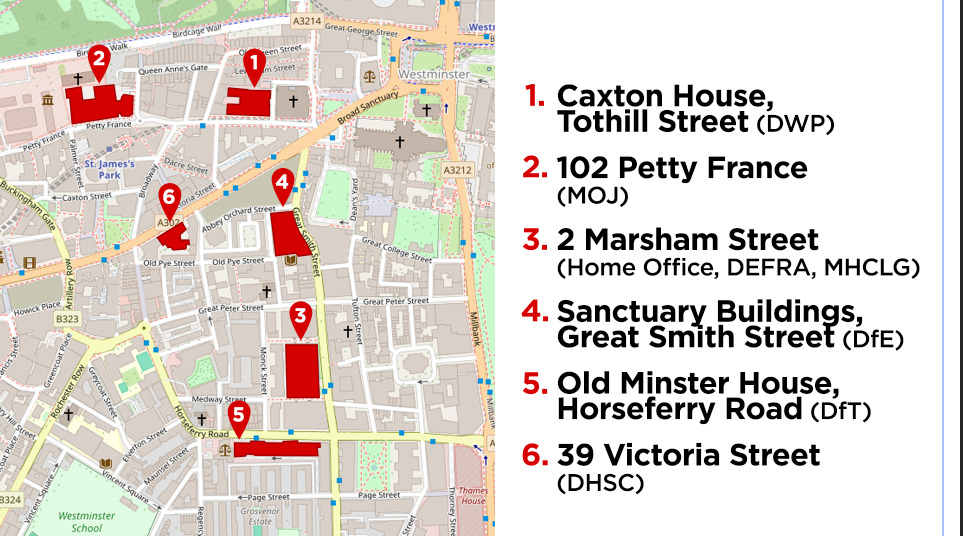
Speculative real estate plan for government
Leases on the following government buildings are due for renewal by the end of the next Parliament:
- Caxton House, Tothill Street (DWP)
- 102 Petty France (MOJ)
- 2 Marsham Street (Home Office, DEFRA, MHCLG)
- Sanctuary Buildings, Great Smith Street (DfE)
- Old Minster House, Horseferry Road (DfT)
- 39 Victoria Street (DHSC)
The intention of Reform UK is to give these buildings up as their leases fall in. In parallel, a process of headcount cuts and relocation beyond London will reduce the demand for office space. We will move the remaining ‘Whitehall’ workforce to Whitehall itself: Government Offices Great George St (the Treasury building), the Foreign and Commonwealth Office, Ministry of Defence Main Building, 70 Whitehall, and Richmond House. The savings from this move cannot be precisely calculated from public sources but it is reasonable to estimate an averted bill of at least £100m per annum.
A New Model System
So I’ve explained that we will be ready for government, and we will take back control of the Whitehall machine.
The third thing we’ll do is this. We’ll make sure the wider system – the institutions outside Whitehall – also respect the mandate of the government.
We expect opposition. Reform’s experience of local government is how a combination of ineptitude, misplaced deference to the way things have been done – often only for the last few years but now hallowed with tradition – and active malignancy, are powerful blockers against change.
Ministers from previous governments publicly and privately bewail the obstructions placed in their way by forces outside their control – or even the control of the civil servants who, as many do, want to see the government succeed.
So for Reform to succeed we need deliberate action beyond Whitehall too. Nigel Farage will not let established conventions, or vested interests, or bogus appeals to higher authorities than the will of Parliament, get in the way of the plan that has been approved by the public in a general election.
I can’t stress enough that the revolution Reform UK is planning is a conservative revolution, like all good revolutions – like 1688 and 1776, when the representatives of the people rose up against an executive that was failing to govern for the nation.
Those revolutions were restorations – and so will ours be. We want to restore the proper basis of our democracy, whereby public servants answer to ministers, who answer to Parliament.
A restorative revolution is not majoritarian. Yes, we will place maximum legitimacy in our mandate; yes, we will not let the establishment countermand the clearly expressed wish of the public.
But we don’t come with a chainsaw, or a wrecking ball. We respect the institutions of the country – the Armed Forces, the police, the church, the judiciary – and we respect the professionalism and expertise of the people who work in them, so long as those people respect in their turn the right of Parliament, and of ministers, to make the rules they work by.
As with Cromwell’s New Model Army, we need the professionals to do their job – running the institutions themselves – but we need them firmly under the supervision and authority of what since the Restoration and the Glorious Revolution we call ‘the Crown in Parliament’: the King’s ministers, arising from and working through the assembly of the people.
That means ensuring the House of Lords does not obstruct legislation passed by the Commons. It means stopping public sector unions sabotaging the reforms the public rightly demands.
And it means exiting international legal conventions, and changing the rules on judicial review, that allow judges to countermand the decisions of the government.
Obviously we need judicial independence. But we need courts to have a proper respect for the boundaries of their remit – to follow statute and precedent faithfully. The price of independence is that the courts should be genuinely non-political, without the power to apply their own notions of what the law should be, let alone to block or reverse decisions rightly made by the government. That is the real rule of law – the independent application of laws made by Parliament.
Parliamentary sovereignty
To recap. We will be ready for government. We will grip the Whitehall machine. And we won’t let the wider system outside Whitehall stop us.
So this is my fourth and final point. The institution we respect the most is our sovereign Parliament. Yes, under our system the Crown is ‘in’ Parliament – the executive governs through the legislature. But Parliament is also the proper, indeed the only rightful, check on the executive. International law, and the civil service, and the quangocracy, and the trades unions – they are not there to second-guess the government. But Parliament is.
Now Reform UK is not best pleased with the current Parliament. Neither House reflects the actual state of opinion in the country. And I think I speak for all MPs when I admit my shame at some of the sessions I have sat through in the making of laws. The farce of the Bill committee system – brilliantly explained in Ian Dunt’s book How Westminster Works – is a particular embarrassment, as is the use and abuse of Statutory Instruments or Delegated Legislation.
Reform UK will restore proper Parliamentary government. Our immediate priorities require legislation that – backed by our election mandate – we will pass as fast as we can. But alongside this rightful urgency, we will reform Parliament to ensure it does its proper job to scrutinise Bills, and hold the Government to account, on behalf of the public.
Call to action
Let me finish with a call to action. We need help now, as we prepare for government. This is the first in a series of speeches and posts in which colleagues and I will be setting out our plans for government. And we invite responses – we invite people to get involved. If you have experience or expertise we want to hear from you.
Zia Yusuf, Richard Tice and my other Parliamentary colleagues and I are setting up a series of advisory groups and sounding boards to gather insights into how things work and how they need to change. If you feel you can contribute – publicly or privately – please get in touch via this webpage…
Because I can’t stress enough the importance of our mission and the weight of the responsibility on Nigel, Zia and the rest of us.
The fundamental reason people are increasingly backing Reform is because they believe us when we say we will bring change.
In 2016 with Brexit, and in 2019 with Boris Johnson, people voted for change but they got chaos and stasis: crisis and drift. The current government came into office promising change – and everything has carried on as before, only worse.
I’m not sure our democracy can stand another government promising change and delivering failure. I know Nigel Farage is determined to be different. But to help him be the Prime Minister the country so badly needs him to be, we need the country’s help.
Step up. Step forward. Get involved. Britain needs Reform, and Reform needs you.
Thank you.
The Lib Dems
The Liberal Democrats (often abbreviated as Lib Dems) are one of the UK's major political parties,...
What is Public Sector Equality Duty.
Protected characteristics are specific attributes defined under the UK's Equality Act 2010 that...
BDS Movement
The Boycott, Divestment, and Sanctions (BDS) movement is a Palestinian-led, nonviolent campaign...